/Assets/base/Close.svg)
 ]
]
/Assets/arrow-facing-left--black-01.svg)
/Assets/base/Navigation%20Icons/TAYA.svg)
/Assets/base/Navigation%20Icons/navigation%20arrow%20-%20facing%20right-01.svg)
/Assets/base/Navigation%20Icons/Sales.svg)
/Assets/base/Navigation%20Icons/Web%20design.svg)
/Assets/base/Navigation%20Icons/HubSpot.svg)
/Assets/Icon%20Library/AI%20Mastery.svg)
/Assets/Icon%20Library/Gear%20icon.svg)

/Assets/Icon%20Library/Learning%20Center%20Laptop.svg)
/Assets/Icon%20Library/Click.svg)
/Assets/Icon%20Library/Link.svg)
/Assets/navigation-global--close-symbol-black-01-1.svg)
/Assets/navigation-global--close-symbol-black-01.svg)

/Assets/Icon%20Library/x%20corp.svg)
/Assets/base/Learning%20Center%20Resource%20Category%20Icons/Facebook_Messenger_logo_black.svg)
/Assets/Icon%20Library/whatsapp%20logo.svg)
/Assets/Icon%20Library/Email.svg)


What is Business Blogging?
Business blogging is as essential to marketing a business as the yellowpages. A business blog is a marketing channel that helps businesses increase visibility online, brand awareness, blog subscribers, and support business growth.
Remember when blogs were secluded to LiveJournal and reserved for nerdy niches? Well, those days are long gone as blogging for business has become a staple of every marketing strategy.
Business blogging is as essential to marketing a business as the yellowpages once were and if you haven't adopted the practice yet, you may be at a serious disadvantage to your competitors.
Fortunately, it's not too late to get started. In this article, I've put together everything you need to know to make up for lost time and start blogging for business right away.
The Truth About Business Blogging
With so much contradictory information (and opinion) being thrown around, it can be difficult to know what to really expect from blogging for business.
Business blogging has evolved quickly and much of the information you find online is simply outdated, even if it was technically true a few years ago.
In 2011, for example, before blogging was fully-accepted as a legitimate marketing tactic for businesses, Daily Blog Tips shared 6 ugly truths about blogging.
At the time, they were all valid points to consider, but as expected with time, many have grown untrue.
These six statements represent common beliefs (and misconceptions) that still exist today. For those of you new to the medium, let's take a few minutes to set the record straight about each one.
"Ugly Lie #1: Business Blogging isn’t easy"
Blogging isn't easy in the sense that the results come quickly with little effort, but when you consider the other ways businesses have used over the years to reach customers, blogging is a piece of cake. (I'm talking funfetti.)
What's easier: blogging or walking door-to-door? Would you rather publish a post a day or make 100 cold calls a day?
I'll stick with business blogging, thanks.
"Ugly Lie #2: Business Blogging isn’t a viable business model"
Now, this one is flat-out wrong today. Between Mashable, Buzzfeed, Gizmodo, TechCrunch, Engadget, and VentureBeat, there are millions being made off of blogging these days.
While most businesses (including IMPACT) use blogging to drive traffic to their website rather than their main source of income, it is very much possible.
"Ugly Lie #3: Business Blogging isn’t all about you"
Ok, I've got to say, they've pretty much hit the nail on head with this one.
Your company blog is all about your buyer persona, not you.
If you're not providing value to your ideal prospects and customers (i.e. answering their questions, addressing their ideas), you're taking the wrong approach to blogging for business and are unlikely to attract traffic or subscribers.
"Ugly Lie #4: You don’t need to interact much with your readers"
Saying that you don't need to interact with readers is almost as bad as saying you don't need to respond to customer service inquiries.
As a business, you need to understand that your blog readers are all customers or potential customers that deserve some attention.
Your brand is heavily judged in the digital age by its online interactions, so the more you connect, the better.
"Ugly Lie #5: Practice doesn’t make you perfect"
Perfection in anything doesn't exist, but business blogging is a skill that will definitely improve with practice.
Take a look at our own blog, for example. Our posts today are light years ahead of our posts from even a couple of years ago and we're only going to improve from here. The same goes for you.
"Ugly Lie #6: You don’t need a lot of blogging advice"
It's all about quality over quantity. If you simply master the fundamentals (listening to your audience and writing quality content), your business blog will be better than 99% of blogs out there.
Expectations vs. Reality of Business Blogging
Now that we've cleared up some misconceptions, let's tackle the issue of what to expect from business blogging.
We all want results yesterday, so our expectations often need a reality-check. Here are four of the biggest.
Expectation #1: Our customers don't read blogs
Reality: Not all of your customers read blogs, but they all use Google to find answers and information. If your blog has the information they're looking for, they'll find that information and discover your brand.
It's extremely difficult to do internet research for a product or service and not end up reading several blog posts. Your customers might not be avid blog readers intentionally, but they'll definitely visit your blog site to read a post if it delivers the information they're looking for.
Expectation #2: If I build it, they will come
Reality: Waiting for blog readers to find you is a waste of time. Business blogs need a solid promotion strategy to get their content in front of their buyer personas.
Over time, yes, they will come -- but you'll grow your blog readership faster by actively promoting your content.
Expectation #3: Every post I publish is going to be awesome because I'm awesome
Reality: As Former IMPACT Content Marketing Manager, Carly Stec, explains:

"You're right. You are awesome, but the truth is, some posts simply miss the mark. Sometimes it's the content and other times it's a lackluster headline. In worst case scenarios, it's both."
- Carly Stec, Staff Writer at HubSpot (Former Content Marketing Manager at IMPACT)

Every blog post isn't going to be a hit, but the good news is they don't have to be for your business blog to be successful. You just need to get it right most of the time.
Expectation #4: Blogging will take up too much of my precious time
Reality: Time invested in your business blog is time well-spent, but blogging is a time-consuming endeavor. If you don't have the time to dedicate to blogging, you should seriously consider hiring someone to do it for you.
Strengthening Your SEO With Frequent Blogging
Search engine optimization (SEO) is crucial for success when blogging for business. Every brand wants to own the first page of Google for their industry, but only a few can.
On-Page SEO
In order to be fully optimized and help your blog articles rank higher in search results, your focus keyword should appear in all of the following “On-Page” SEO areas: URL, Page Title, Section Header, Subheaders, Main Content, Image ALT Text, and Meta Description.
To illustrate this, let’s say you are creating a new article centered around the keyword: “Organization Optimization”:
Page Title (H1) (Max. 70 Characters): Organization Optimization Through [Your Company’s Name]
Section Header (H2): How Can [Your Company]’s Technology Help Your Organization Optimization?
Page URL: https://www.yourwebsite.com/organization-optimizationtechnology
Main Content (Within the first 200 words): “Effective organization optimization can help improve your employee experience, company culture ..”
Image ALT text: organization-optimization-through-technology Meta Description (Max. 150 characters): Learn more about how [Your Company]’s technology for organization optimization can benefit your business.
In addition to these on-page elements, one of the most effective (but often underappreciated) ways to dominate SEO is to blog more frequently than your competitors.
Frequent Blogging
As any online marketer will tell you, every customer started simply as a visitor to their website. According to HubSpot, 78% of Internet users conduct product research online.
By frequently blogging fresh, relevant content focused on solving the problems of your consumers, you’re effectively producing more indexed pages to be picked up by the search engines.
Why is this significant?
Well, simply put, when close to 80% of all Internet users are searching for product information through search engines, wouldn’t you rather your blogs to be a resource for these users rather than your competitors?
Of course, you would.
What’s Considered Fresh & Relevant?
Fresh, relevant content refers to the practice of creating original content that directly addresses those problems or challenges your consumers are having on a consistent basis.
Pulling content from other industry blogs or rehashing the same ones continuously will actually have the reverse effect on your site. In fact, Google actually penalizes sites that employ duplicate content, negatively impacting your search engine ranking.
At IMPACT, we produce our own content daily, focusing mainly on offering helpful, relevant blog articles for our target audience that also tie into the services offered here at our agency. This not only drives new traffic, but also return traffic from subscribers.
Why Content is the “New SEO”
Content marketing has been declared across the marketing industry as the new SEO. Because of this, your website will get buried alive without fresh, relevant content, mainly in the form of blogging.
This has become even more important due to the changes Google has undergone in the past few years.
To drive home the importance of great content, you only need to take a look at Google’s Webmaster Guidelines:
“Make sure that your site adds value. Provide unique and relevant content that gives users a reason to visit your site first.”
The only thing left to say is, what are you waiting for?
How do I ensure frequent blogging?
At IMPACT, we utilize the many resources in our own office to help produce fresh, quality, and relevant content every day.
We’re also involved with various industry experts so that our client blogs are fully optimized to feature helpful, compelling content for the required target audience.
If maintaining a frequent blogging schedule sounds like too much given your schedule, contact IMPACT today and learn how we can help.
How Many Blog Posts Should Your Business Publish Each Month?
In 2015, HubSpot published blogging data accumulated from their 13,500+ customers to answer this question.
"Companies that published 16+ blog posts per month got almost 3.5X more traffic than companies that published between 0 - 4 monthly posts."
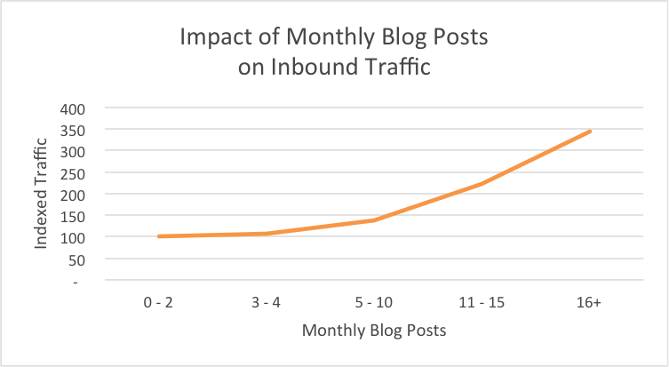
It turns out that higher blogging frequency benefits companies of all sizes.

"B2B companies that blogged 11+ times per month had almost 3X more traffic than those blogging 0 - 1 times per month."
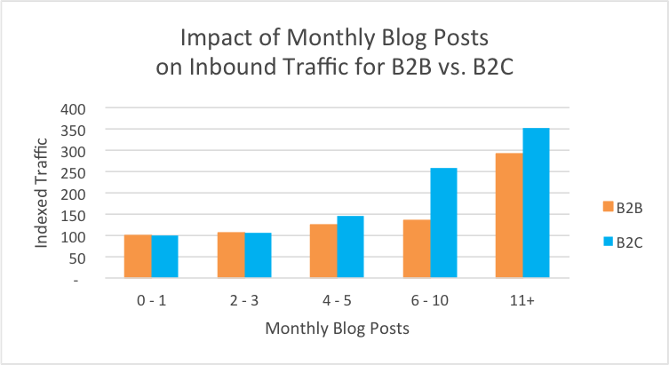
Blogging frequently does more than increase organic traffic, it also generates more leads.

As your publish more and more posts, the total number of indexed pages keeps going up. It turns out that once businesses have published 401 blog posts or more, their traffic is nearly double that of businesses with 300-400 total blog posts.
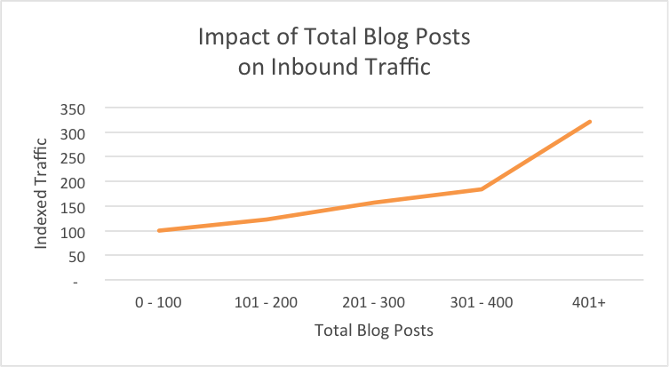
Since organic traffic (that results from improved SEO) is a valuable source of leads, it's no surprise that businesses also increase their lead generation once they've published 401+ total blog posts.

Blogging Checklist: How to Build an Effective Business Blog
Not sure how to get set up for business blogging success? Follow this simple 10-point checklist from our Community Coordinator, Carolyn Edgecomb.
1. Allow for Blog Subscribers
Too many companies miss the value of obtaining loyal blog readers. The more readers you can get to subscribe to your blog, the more opportunity you have to fill the top of your sales funnel and increase the number of visitors coming to your website regularly.
2. Ensure Your Blog & Website Are on the Same Domain
One of the top biggest benefits of blogging is to build SEO value for your website. By placing your blog on a separate domain, you're separating the SEO value of your blog and website, hurting the performance of both. It’s critical that your blog lives on the same domain as your website, such as blog.domain.com or domain.com/blog.
3. Implement a Routine Publishing Schedule
Blog readers like consistency and the ability to know when they can expect new content; therefore, you need to develop a consistent blogging schedule. Whether you blog monthly, weekly, daily, or multiple times a day, keep it consistent. Don’t just post articles as your write them. Use your blog scheduling tool to release your content on a routine basis.
4. Generate Enough Blog Articles to Achieve Traffic Goals
How many blog articles are you creating each month? If you’re not creating enough blog articles you might not be meeting your traffic goals for the month.
Publishing a blog article about a current topic or industry trend is a great way to bring more traffic to your site. Don’t just blog so many times a month, publish more blog articles, if necessary, to help your company achieve their goal.
5. Integrate Social Share Buttons
One necessity of every blog is social share buttons. How else are your readers going to share that fantastic article you recently published? The success of your blog depends on how many people actually read it! Did you know that social sharing buttons increased click through rates by an astounding 55%?
6. Implement a Clear Call to Action Into Each Article
There is no better way to maximize the potential of conversions from your blog than through a clear and compelling call to action.
You should always provide your readers and visitors with some direction. There’s no better time than after reading one of your blog articles. Utilize a call to action that’s relevant to the content on every blog post. An even better way to target your readers and audience is by adding sSmart CTAs.
7. Create Blog Content for Buyer Personas
Don’t just write. You need to develop content that targets your buyer personas. Your buyer personas aren’t going to read your blog posts if the content isn’t related to the type of service or product they’re looking for. Don’t just see your blog as a platform for you to talk about current trends and topics. Think of your blog as a way for you to educate your buyer personas and a way to engage with them to push them down the sales funnel.
8. Optimize for Mobile & Speed
Your readers’ time is valuable and they don’t want to wait for your slow blog to load. Test your website’s speed using online tools such as webpagetest.org to identify opportunities to reduce load-time. One of the biggest culprits is oversized photos.
Also, with the rapid increase in internet browsing on mobile devices, it’s critical that your blog is accessible and optimized for smartphones and tablets.
9. Ensure Blog is Completely SEO Optimized
No one is going to find your blog if it’s not optimized for search engines. Identify a focus keyword for all marketing content you produce, and ensure it’s prominently featured in page titles, headers, alt tags, and images. By doing this, you’re increasing your opportunity to rank higher in search engines significantly.
How important is a high ranking? Incredibly, considering that according to Marketshare, 75% of users never scroll past the first page of search results. Be sure to link to other relevant content in your posts as well, as this helps to drive traffic to other areas of importance as it relates to your marketing goals.
10. Identify Your Blog Authors
You have a unique voice in your industry, ensure this is on full display by including a name and even a face to go with each blog you publish.
This helps to establish your credibility as an industry thought leader and also builds trust with your audience.
A few more outside perspectives:
Essential: A 44-Point Checklist for Starting a Quality Blog
by Ramsay Taplin at Blog Tyrant:
The Ultimate Blog Marketing Checklist: 57 Tips
by Mike Murray at Content Marketing Institute:
The Ultimate Blog Writing And SEO Checklist
by Inklyo at Business 2 Community:

Business Blogging Tips for People Who Hate Writing
It's hard to get excited about blogging for your business when you hate writing (which many people do). Fortunately, you don't have to be a great writer, or love writing, to create a successful blog.
All I need from you is an agreement that publishing content is critically important to your marketing efforts right now. We all know this, so let's not focus on theory and get right down to helping make it a more manageable process.
Here are 5 tips once shared by our former Marketing Director, John Bonini once shared.
1. Record and transcribe
Contrary to what you may believe, great writers don't necessarily have an abundance of free time on their hands. Many are even expert procrastinators and find the hardest part of writing is, in fact, getting started.
What the great ones do, however, is carve out those invaluable periods of time where they can be productive and hit their word counts.
You don't have one. And that's okay because you can manufacture it right now. First, let's think about a time during your day where you're alert, attentive, yet free of any responsibilities. Maybe it's your morning commute. Or when you're waiting to pick the kids up from practice. Whenever it is, this can be your time.
Find a topic that makes sense for your business, or maybe a common question you hear from prospects and customers. Write down as many of them as you can. Every day during your window of opportunity, record yourself talking all about these topics (i.e. using your smartphone or another audio recorder). Don't worry about organizing your thoughts. Just talk.
Later on, take a seat in front of the computer and transcribe everything you said. Organize it in a way that makes sense, with paragraph breaks, headers, and maybe even some bulleted lists.
Before you know it, you'll have the makings of a solid blog post. Notice how we found a way around the traditional "writing" portion?
2. Outline
There's nothing worse for someone who hates writing than a blank screen and no direction. This is not the same as Picasso pondering a blank canvas, and more an opportunity for a beleaguered writer to anguish and express cursory remarks in front of the whole office.
In other words, it's bad news for everyone.
Never attempt to write without an outline. Ever. That'd be like a novice chef cooking without a recipe. Would you eat it? (Don't answer that.)
A great outline should contain:
- Takeaways – List everything a reader would learn after reading your article.
- Sections – Organize the takeaways into segments that relate to each other.
- Talking points – Briefly list major talking points for each section that support the takeaways.
Sounds simple, but if you give this process the respect it deserves, it'll make writing the article more paint by numbers than creating from scratch.
3. Crowdsource your ideas
One of the most common challenges I hear among aspiring bloggers is, "what the hell do I blog about every day? Won't I run out of ideas?"
Well, not unless your customers stop running out of challenges or questions.
Make it a habit to comb through your social networks every day looking for ideas. What types of challenges are people talking about? Not sure how to find this? Simply tack the word "problems" to the end of your industry and hashtag it.
Marketing agency? Look up #marketingproblems.
IT company? #ITproblems.
You get the idea. Social media is fertile ground for discovering ideas and finding questions that need answering. Once you find them, you're doing less writing and more answering.
Pro tip: Check out our interactive blog title generator and you'll never run out of ideas. Promise.
4. Write drunk; edit sober
The most frustrated of writers tend to over edit. Before they finish a sentence they're already thinking about everything they hate about it. What happens next is a vicious cycle of writing and backspacing that leaves you still working on an introduction three hours later.
Take a little advice from Ernest Hemingway (he knew a thing or two about writing) and write drunk and edit sober.
Now, before you go clamoring for your flask, understand the interpretation is more about writing without the limits of editing on your mind. Simply write. Then write some more. Your writing process should be a freewheeling transport of thoughts and ideas from your brain to your processor of choice.
Once you have everything down, that's when you go back and make your edits.
5. Give yourself a break
Another misconception about writers is that it comes easy. They simply sit down, stroke the keyboard for an hour or two, and voilà, the next great American classic is born.
Even the most prolific writers need a break. A walk. Hell, even a drink.
So, don't be so hard on yourself. If you're not feeling it right this second and time permits, give it a break. Sleep on it. Come back refreshed and you'll notice your approach will be much more deliberate and productive.
Give yourself permission to get up. To say, "I'm just not where I need to be mentally right now."
Great writers look productive because you don't see them when they're not feeling it. Granted, deadlines are real, and sometimes you just have to grind it out, but save that for the times when it's necessary.
Otherwise, cut yourself some slack.
If you find yourself hitting a wall, take a break or sleep on it and come back with a rested mind. You'll be amazed at the difference it makes!

In a 2014 article, Entrepreneur.com staff writer, Catherine Clifford, shared 8 Writing Strategies for People Who Say They Can't Write that you might also find helpful:
- Drop the "I'm just not a writer" mindset and tell yourself: "I am absolutely capable of writing!"
- Don't wait for the perfect words. Start writing, no matter how messy it looks, and the right words will find you.
- Talk to yourself out loud to get your ideas flowing and to develop a conversational approach to your writing.
- Treat your blog post like a puzzle - move words, sentences, and paragraphs around until they fit just right.
- Crystallize your main point into a few words. Once you get to the core of your message, your writing will be more concise.
- Eliminate distractions by going offline. Temporary time away from the internet is incredibly effective for writing productivity.
- Don't worry about starting at the beginning. Start writing any part of the blog post that easiest for you to start with. Then go back and fill in the rest once you've built up some momentum.
- Set deadlines and stick to them. Sometimes we need to apply a little pressure on ourselves to get things done.

Proper Etiquette When Blogging for Business
While many businesses have adopted a less buttoned-up approach to interactions and endeavors, manners still matter.
Much like placing your napkin on your lap, or avoiding talk of politics at a cocktail party, proper etiquette should play a prominent role in your business blogging efforts.
If we keep trucking down the path we're on, it will only be a matter of time until we're all justifying sweatpants as real pants and Facebook shout outs as the proper way to wish a friend a happy birthday. Scary, isn't it?
So before we all lose sight of common courtesy as a whole, I think it's about time that we dust off that old, antiquated guide to etiquette.
It's time that we start treating our audience with a bit more consideration. In a competitive marketplace, businesses who follow these 5 business blogging etiquette rules will be the ones who get noticed.
1. Write For Your Audience, Not Yourself
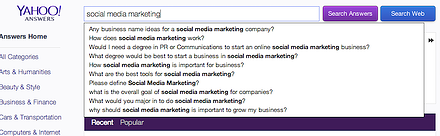
If you're writing self-serving content, be prepared for it to flop.
Many times I find that I talk myself out of potential blog topics that seem "too introductory", I mean, I know the answer, so everyone else must know it too, right?
Wrong.
Business blogging isn't so much what you feel like writing about that day, but rather it's more about what you audience wants to read.
But how do you uncover what it is that your audience wants to read? Research.
Q&A sites like Yahoo Answers, Google Trends, and even your social media platforms have proven their ability to connect bloggers to relevant topics time and time again, so consider looking into one of them before your next post.
While we're on the subject of writing for your audience, be sure to avoid over-complicated industry jargon. Contrary to popular belief it won't make you sound smarter, it will just confuse your audience and persuade them to seek information elsewhere (Please! No. Don't go!)
2. Don't Overlink
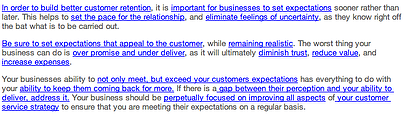
Don't get me wrong, sprinkling your content with relevant links is a vital part of the blog optimization process.
Linking back to older posts will help you to drive your point home while driving people back to posts that could use the traffic. Links that contain keywords will help you improve your search rank, and they help Google crawl your site. However, sometimes too much of a good thing becomes a bad thing.
You want your internal links to be relevant and serve a greater purpose. Linking every other word for no rhyme or reason will not just disrupt your writing, but it won't settle well with your reader.
When readers click on links, it's likely that they're looking for clarification and more information. If the link directs them to an irrelevant blog post, they're going to feel mislead and perhaps lose trust in your business.
Additionally, be sure that any links you insert are set to open in their own tab or window. Links that redirect within the same window will steer traffic away from the blog post at hand before they even finish reading.
3. Respond to Comments
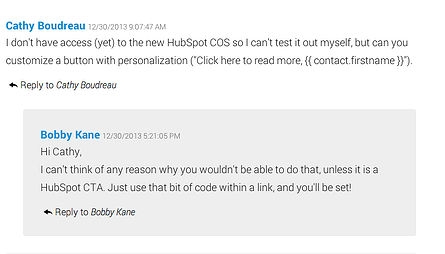
Every time I receive a positive blog comment, I take a moment to enjoy the fruits of my labor. The fact that my message evoked a positive reaction from someone else is rewarding for sure, but how about a negative one?
Rather than pout about it, I've started to take negative blog comments with stride. After all, any feedback is good feedback, and each negative comment I receive can be used to inform and improve my future posts, right?
The point is, whether it's good, bad, or ugly, blog comments shouldn't go unanswered.
Whoever these commenters may be, they're the ones responsible for driving your blog traffic every month and they deserve some recognition.
If they've presented you with a question, answer it. This simple gesture will help to position you and your business as both credible and authoritative.
If you're wrong, admit your wrong. If you're unsure of what they mean, ask for clarification. Use their name and speak in a language that they understand. It's really that simple.
4. Give Credit Where Credit is Due

Plagiarism is a slippery slope. If you're going to reference someone else's work within your own, be our guest, but don't forget to give them the accreditation they rightfully deserve.
If you use a statistic you found on someone else's blog, attach a link back to the article in which you found it. Not only is this proper etiquette, but it helps to provide a path for readers who may be looking for more information that aligns with that particular statistic.
Additionally, including a link back to the original source will also help to improve the credibility of a stat or quote. I don't care how compelling a statistic is, if I can't find a source, I'm not going to risk misinforming my audience.
The same can be said for photo usage. If you're looking for someone to empathize with about the trials and tribulations of finding high-quality images for your blog posts, you're barking up the right tree.
Just because a photo turns up in Google images doesn't make it fair game. In fact, unless an image or website clearly states that you have the right to use their images without the need to pay royalties or a licensing fee, don't even go there.
Even when you use images from a royalty-free site, make sure that you include a link back to the original source.
5. Break Up Your Copy
Nobody sits down to a blog post and expects to read a 500-page novel, it just doesn't work that way. The format of your blog posts, like the content, should align with your audience's behavior and interests.
Keep it simple. While you want to be sure that you're providing as much value as possible, lengthy blog posts are being trampled by the demand for more digestible, to-the-point content.
Tightening up your content doesn't mean getting rid of important details, but simply finding the best possible way to present your information to ensure that people will actually read it.
This means using bulleted lists to break up bulky information, and rereading your work a time or two to uncover places where you could insert a break.
Delete the fluff, keep the good stuff.
The Do's and Don'ts of Blogging for Business

Darren Rowse, founder of ProBlogger, shares several do's and don'ts for bloggers that will ensure you're creating a great brand image and setting yourself up for success.
The Do's:
- Set goals for your blog
- Do as much as you can to understand your buyer personas
- Use surveys and polls to understand your blog readers
- Create content that solves problems, answers questions, and meets the needs of your buyer personas
- Write in an engaging, conversational way
- Create a newsletter to share blog posts directly with subscribers
- Pay attention to design - the first impression matters
- Create visual content
- Share stories and opinions (when appropriate)
- Blog with passion
The Don'ts:
- Don't be afraid to hit publish
- Don't become too promotional
- Don't write purely for search engines
- Don't feed the trolls
- Don't give up too quickly - building a successful blog takes time

Why You Should Keep Blogging (Even When it Feels Like No One is Reading)

"The other day I came across a figure that stated that a new blog is created somewhere in the world every half a second. (Source: BWHGeek)
I'll give you a minute to wrap your head around that.
(One minute later.)
It's no secret that the competition is fierce, but giving up on your blog because of low readership means giving away opportunities.Rather than look at your slim subscriber list from a "glass half empty" perspective, consider how lucky you are to have earned their attention despite the overwhelming competition.
Maybe people aren't flocking to your posts like you envisioned in your dreams, but if you keep at it, the rewards are sweet. "- Carly Stec, Staff Writer at HubSpot (Former Content Marketing Manager at IMPACT)

Even average content will generate traffic and leads if consistently published and promoted effectively.
So before you close shop, consider the following reasons why you should keep on blogging on.
Practice Makes Perfect
Blogging is a skill that will improve with practice. The best way to write better is to write every day.
Just as you would exercise any other muscle in the gym, you have to exercise your writing muscle to get stronger. You'll also improve your blogging by getting more strategic as you master the best practices.
Consistency Boosts SEO
Remember, the more blog posts you have, the more traffic and leads you'll generate. Consistency raises you total blog count faster.
Don't write posts aimlessly - you need a plan. Learn about Keyword Research.
Enjoy Inbound Sales
Inbound marketing is more than marketing alone; it includes sales, as well. The Inbound sales approach relies on blogging to generate high-quality leads in massive quantities.
Blogging is B2B lead generation 101.
Key Takeaway
Blogging for business is more challenging than it's often made out to be, but the potential benefits are all real.
It will take some persistence at first, but hang in there until your SEO kicks in, so to speak. Once you've published those first 50-100 blogs posts you'll see a significant boost in traffic.
It grows exponentially after you've published 401+ post.
Successfully blogging for your business comes down to creating value for your buyer persona consistently.
Creating value includes:
- Publishing high-quality content
- Optimizing design for speed, functionality, and of course, mobile
- Nurturing leads on your mailing lists
- Engaging with your buyer personas on social media
You don't have to be a great writer to be a successful marketing blogger. You don't even have to write.
You can record yourself and have it transcribed. Even better, you can hire someone else to do it for you!
It's important to remember the proper etiquette for business blogging. You want to establish your value proposition and build a positive reputation for your brand.
You might feel discouraged at first when the readers barely trickle in, but stick with it and your posts will be generating hundreds of qualified leads for your business each month.
Free Assessment:
/Assets/Icon%20Library/Arrows/Grey%20Arrow%20-%20Prev.svg)
/Assets/Icon%20Library/Arrows/Grey%20Arrow%20-%20Next.svg)






.png)