/Assets/base/Close.svg)
 ]
]
/Assets/arrow-facing-left--black-01.svg)
/Assets/base/Navigation%20Icons/TAYA.svg)
/Assets/base/Navigation%20Icons/navigation%20arrow%20-%20facing%20right-01.svg)
/Assets/base/Navigation%20Icons/Sales.svg)
/Assets/base/Navigation%20Icons/Web%20design.svg)
/Assets/base/Navigation%20Icons/HubSpot.svg)
/Assets/Icon%20Library/AI%20Mastery.svg)
/Assets/Icon%20Library/Gear%20icon.svg)

/Assets/Icon%20Library/Learning%20Center%20Laptop.svg)
/Assets/Icon%20Library/Click.svg)
/Assets/Icon%20Library/Link.svg)
/Assets/navigation-global--close-symbol-black-01-1.svg)
/Assets/navigation-global--close-symbol-black-01.svg)

May 21, 2022
/Assets/Icon%20Library/x%20corp.svg)
/Assets/base/Learning%20Center%20Resource%20Category%20Icons/Facebook_Messenger_logo_black.svg)
/Assets/Icon%20Library/whatsapp%20logo.svg)
/Assets/Icon%20Library/Email.svg)

Writing great blog content is hard, even in the best of circumstances, but it’s made all the more difficult if you don’t have an editorial calendar to keep track of what you should write about and when.
A good calendar can keep your entire content marketing initiative organized — so you can be sure to cover the right topics (i.e. what They Ask, You Answer calls The Big 5) and publish at a steady cadence.
If you don’t have a reliable way to stay organized, however, you’re all the more likely to stumble and fall.
We’ve seen clients struggle with content marketing for this precise reason — not because they didn’t have the knowledge or the skill, but because they didn’t have the tools to stay organized.
At IMPACT, we believe that a steady publication cadence is vital to inbound marketing success, and a great editorial calendar is essential to publishing at a steady clip. When we work with clients, we help them set up a durable, repeatable process to stay on track and achieve their long-term goals.
Below, I'll share much of the same information we provide to our clients including:
- Editorial calendar template examples and project management tools
- Examples of calendars to inspire yours
- Tips to keep your content production process running smoothly
Ready to build your calendar and organize your content marketing? Let’s get started.
Editorial calendar template tools
Calendars and project management tools are essential to a strong content creation strategy.
A good editorial content calendar includes the titles of upcoming blog posts, as well as publication dates, information about strategic direction (like relevant keywords), and any other relevant details to keep the content writer on track.
Without an editorial calendar, content creators are often left scrambling to find a topic right before it’s needed. This puts the team at risk of not staying on a consistent publishing schedule or even writing redundant articles that keep covering the same ground — all while overlooking other opportunities.
To build an editorial calendar you basically need three things:
- A list of topics (coming from keyword research, brainstorm sessions, content requests, etc.)
- A calendar template
- A spreadsheet or project management tool
Let’s talk through how you get each one, starting with a list of topics.
A list of topics: 7 ways to build your content backlog
As a content marketer, you must always be on the hunt for article topics. This will allow you to develop a hefty backlog of content ideas that you can plug into a calendar to keep yourself on track.
Use these seven practices to ensure that you’re always thinking about future content that won’t publish for months — even as you stay focused on your immediate content strategy.
- Keyword research: Use tools like Semrush, Ahrefs, and AnswerThePublic to see what words and phrases people are searching for related to your industry. Even free versions of these tools will show you search volume, ranking difficulty, and other key information.
- Brainstorms: Run regular brainstorms with team members to generate content ideas. Sales reps are great resources for knowing exactly what your customers want to know — and service and product designers know technical specs and industry trends. Pick their brains to generate topics.
- Sales calls: Members of the marketing team should commit to watching at least one sales call recording per week. There’s no better way to truly understand your customers.
- Requests from team members: Build a process by which a team member can submit topic ideas or requests for content they’d like to see published. A simple Google form is sufficient.
- Historic optimization: If you’ve been producing content for a while, there’s a good chance some older content could use a refresh. Your historic optimization process could be as simple as updating links, images, and examples — or as involved as a total rewrite. But putting a better, rewritten article under an existing URL is a great way to boost traffic.
- ‘Current events’: Take the pulse of your industry. If big news comes out, you might want to cover it and explain its relevance to your audience. If you’re in real estate and a new federal program is rolling out, explain it. If you’re in manufacturing and a new material is going to revolutionize the industry, explain it.
- Adjacent products or services: When someone buys whatever you sell, what other purchases could be bundled with it? If customers are buying your furniture, they might also be ready to paint their walls or install new lighting. Even if you don’t sell paint or light fixtures, you can still review options, compare brands, and evaluate quality. This content is valuable to your customers even though you don’t sell the product yourself.
Like I said, a good content marketing manager is always on the lookout for new blog topics. If you’re ever in doubt about whether a particular topic is worth covering, ask yourself a simple question: Would the information I’m going to provide in this article help someone become a customer?
If yes, proceed. If not, circle back to your sales team to make sure your content is on target.
At IMPACT, we believe that every content marketing strategy should focus on answering customer questions in a transparent and trust-building way. As you build your content list, keep your customers in mind. After all, they are who your content is really for. Don't forget that.
Editorial calendar tools: Keeping yourself on track
To create an editorial calendar, you’ll need a tool to help you. You can get by with a simple spreadsheet, or you can start with a template tool.
Finding the right template tool
There are some great ready-made options/processes available for you to use for your own editorial calendar, including these from:
Each option will walk you through setup and use. If you’ve already accumulated a backlog of content ideas using the processes listed above, you can start populating your new content calendar with real blog topics.
If you prefer your the spreadhseet approach, you can consider creating a simple excel or Google spreadsheet template like this:
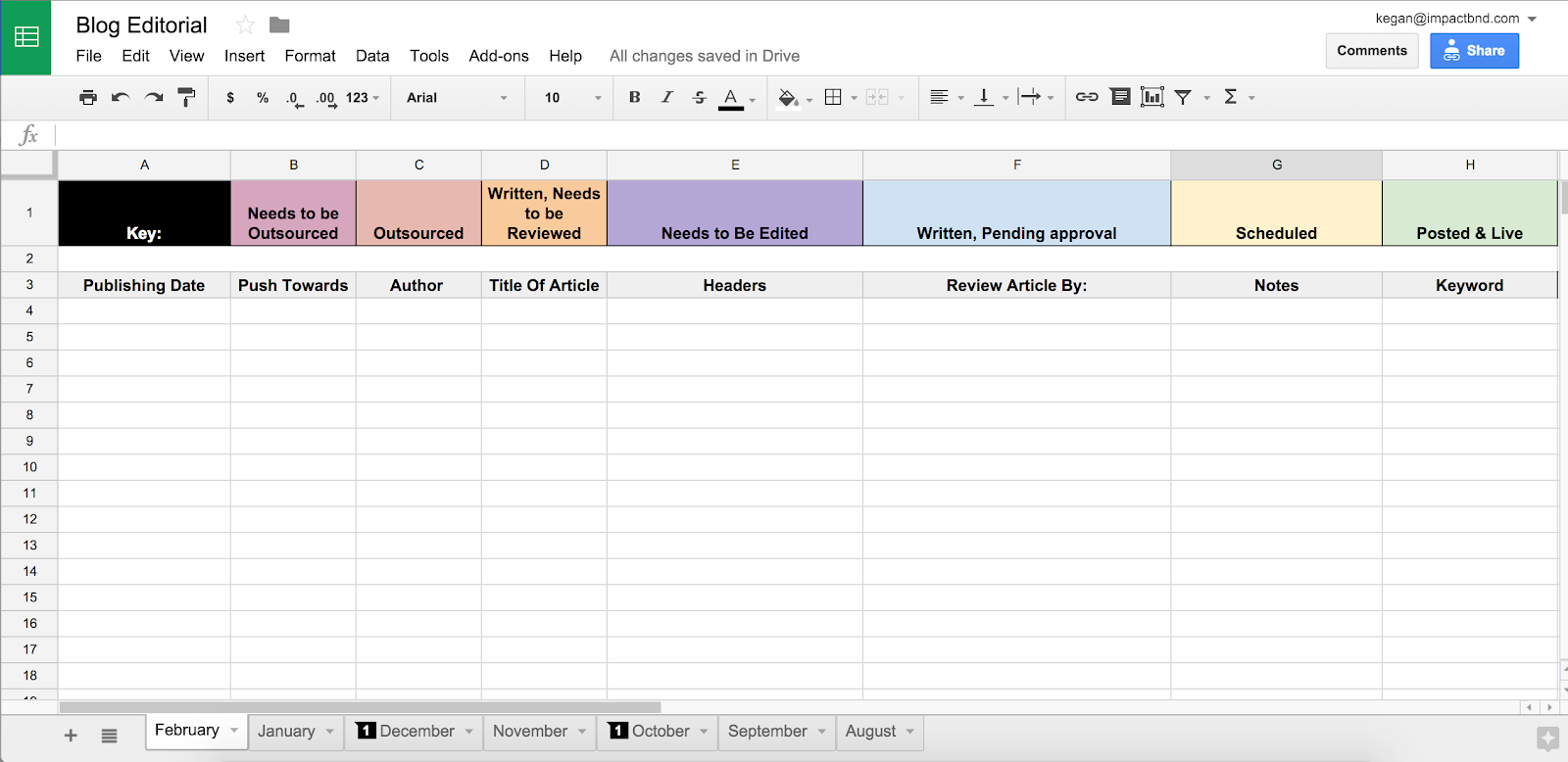
With this option, you’ll be able to customize your fields and fill in the cells with all of the important information you need for a blog article, such as: publishing date, audience, blog title, notes, and keywords.
While this may require a little more set-up on your part, it’s very easy to use once you create your base template and it can be easily paired with your Google Calendar to remind you as you move each piece through the content production process.
Building your calendar
Sticking to a consistent publishing schedule is a challenge, but having an editorial calendar helps keep things organized and planned ahead of time to help prevent this.
It’s important to first know how often you should be posting each week to achieve your goals.
At IMPACT, we advise our clients to publish a minimum of three articles per week — and they do this on the days and times their sites get the most traffic. This is a good baseline for your organization to start with as Google favors websites that are updated regularly.
After a few months, take a look at how those are performing and then refine your strategy accordingly (e.g., increase content production, adjust your focus, publish on different days, etc.).
Once you know how often you should be posting, you can create a schedule and due dates in your blog editorial calendar. Then you have a set plan for the month, giving you plenty of time to make sure you’re going to hit those dates.
Using project management tools
At IMPACT, we use ClickUp to manage our entire workload, including articles. It allows us to estimate and track time, communicate with other stakeholders, and move projects forward.
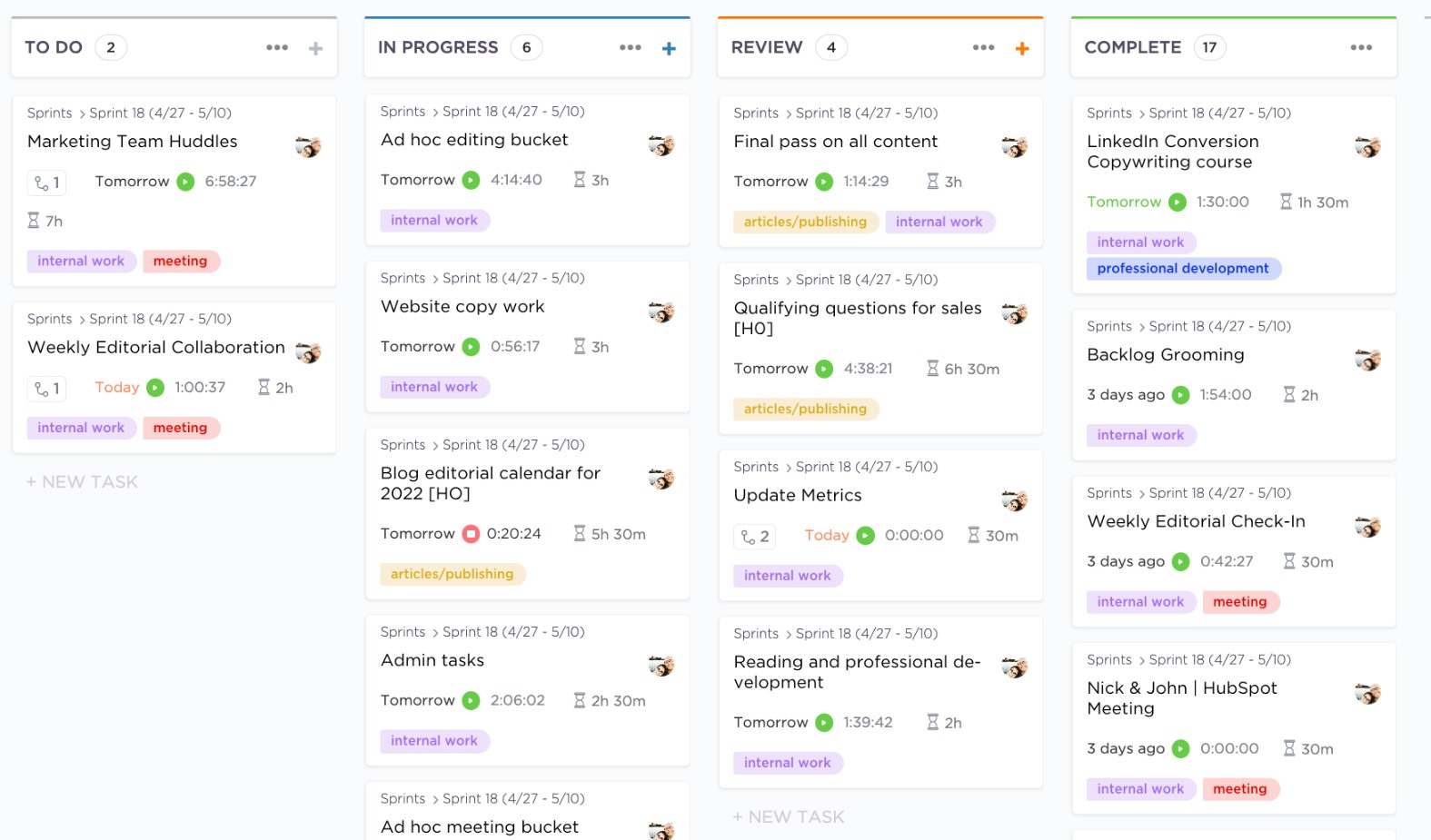
But we also use Google Sheets to map out our calendar for the coming quarter and check things off when they get published.
For us, this double system works. ClickUp is great for managing tasks and compiling a content backlog, and the spreadsheet gives all team members a clear picture of upcoming content and what’s already been published.
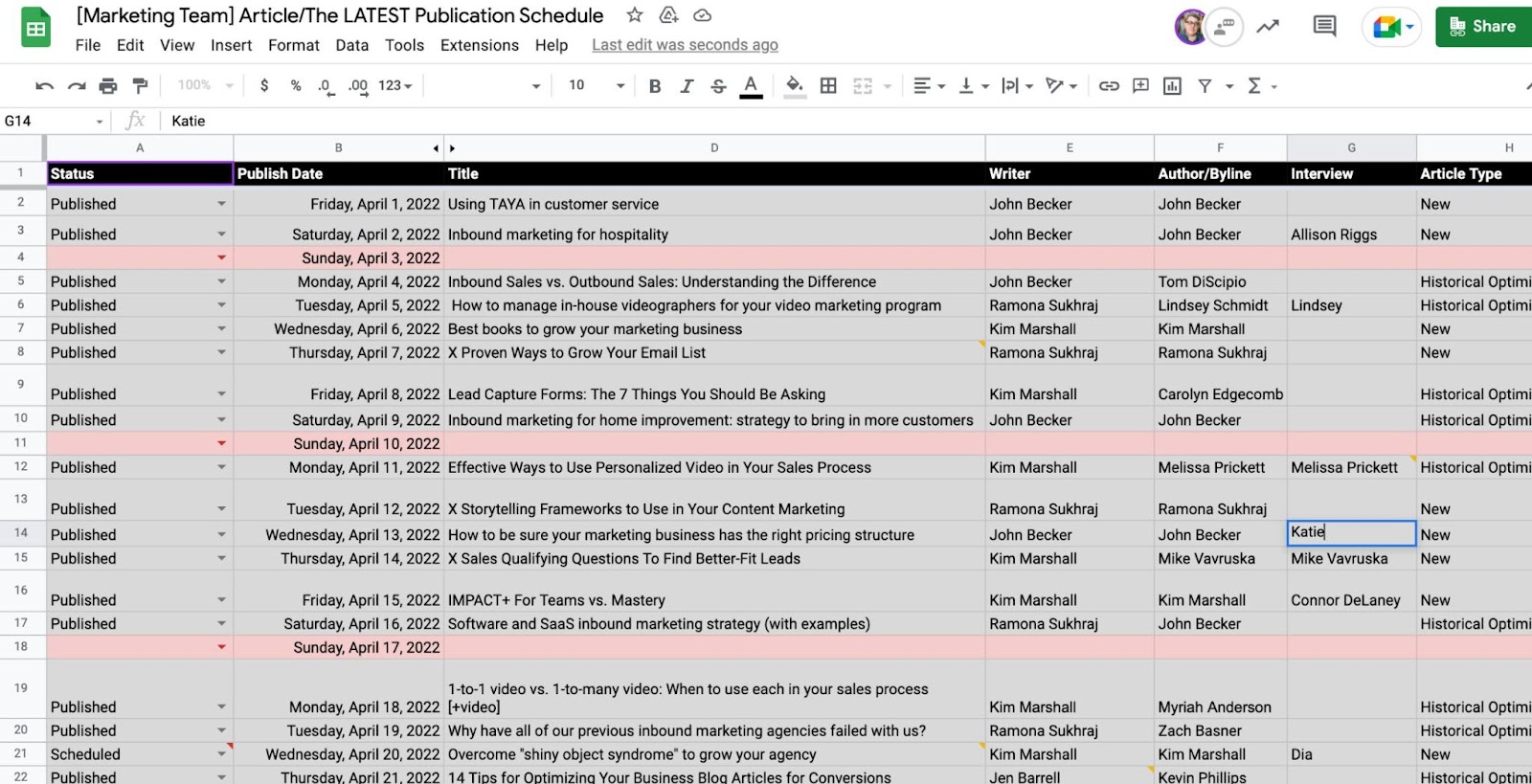
We sort our spreadsheet by content types (new article, pillar page, historic optimization, etc.), and also track interviews, images, and SEO guidelines.
We meet twice a week to check in about our content calendar. In these meetings, we update the team on blog article progress, address impediments, and generally make sure we’re all on the same page about our editorial plans.
5 tips for content calendar success
Templates and tools are great, but you’ll need a solid strategy and a diligent work ethic to succeed with content marketing. Make sure you’ve got the processes in place to keep it up for the long term.
Here are a few tips to keep you on track.
- Remember, quality content takes time: Plan ahead and give yourself plenty of time. A rushed process results in a sub-par outcome. We like to see our clients about three weeks ahead of their content. In other words, on any given day, they’ve already got content scheduled for the next two weeks, and they’re creating content for the week after that.
This only works if you’ve built a bulletproof process to maintain your publishing cadence. - Make a plan to historically optimize existing content: Content trainer Jen Barrell advises her clients to spend up to a third of their writing time updating older content that has slipped in the rankings. You should have a running content backlog of articles in need of updating so you can drop these into your content calendar as time permits.
- Build relationships with your SMEs: You might need to interview subject matter experts (or SMEs) at your company to produce thorough, accurate content. Design a process that ensures you get the information you need and the SMEs enjoy the experience.
- Tracking progress is essential: For your efforts to be successful your whole team needs to commit to tracking progress and updating calendars, spreadsheets, and boards so there’s transparency and accountability. When someone drops the ball or forgets to update, the tools can be rendered worthless.
- At all times, focus on your customers: Your website should provide visitors with all of the information they need to become customers. All content should be transparent, educational, and non-salesy. Your buyers are looking for information, not a sales pitch.
Time to get started!
Publishing content that’s valuable to your buyers is a sure-fire way to bring in traffic, convert leads, and close sales. A library of trust-building content can revolutionize your business. It won’t happen overnight, though — and it won’t happen at all if you don’t build a backlog, develop a blog calendar, and stick to it.
Use the tools and tricks above to keep your editorial process organized.
If you’re lost, or lacking direction, reach out to IMPACT. We’ve helped thousands of businesses like yours to use a proven inbound marketing framework to develop a durable content production strategy.
Free Assessment:
/Assets/Icon%20Library/Arrows/Grey%20Arrow%20-%20Prev.svg)
/Assets/Icon%20Library/Arrows/Grey%20Arrow%20-%20Next.svg)