/Assets/base/Close.svg)
 ]
]
/Assets/arrow-facing-left--black-01.svg)
/Assets/base/Navigation%20Icons/TAYA.svg)
/Assets/base/Navigation%20Icons/navigation%20arrow%20-%20facing%20right-01.svg)
/Assets/base/Navigation%20Icons/Sales.svg)
/Assets/base/Navigation%20Icons/Web%20design.svg)
/Assets/base/Navigation%20Icons/HubSpot.svg)
/Assets/Icon%20Library/AI%20Mastery.svg)
/Assets/Icon%20Library/Gear%20icon.svg)

/Assets/Icon%20Library/Learning%20Center%20Laptop.svg)
/Assets/Icon%20Library/Click.svg)
/Assets/Icon%20Library/Link.svg)
/Assets/navigation-global--close-symbol-black-01-1.svg)
/Assets/navigation-global--close-symbol-black-01.svg)

/Assets/Icon%20Library/x%20corp.svg)
/Assets/base/Learning%20Center%20Resource%20Category%20Icons/Facebook_Messenger_logo_black.svg)
/Assets/Icon%20Library/whatsapp%20logo.svg)
/Assets/Icon%20Library/Email.svg)

![30 Days of New Content Ideas for Your Business Blog [Infographic]](http://145335.fs1.hubspotusercontent-na1.net/hub/145335/hubfs/30-days-new-blog-content.jpg?length=1200&name=30-days-new-blog-content.jpg)
 Keeping blog content fresh is tough.
It's like a banana (but it's not as delicious in bread form.)
People in every industry struggle to come up with new ideas and it is not uncommon to end up repeating yourself, but this can only work for so long.
Eventually, every Marketer reaches a point where they feel tapped out or that their audience is getting bored. That's where this list comes in.
Below are 30 new content ideas for your business blog -- one for every day of the month.
Add these to your editorial calendar and see what works. Once you know what types of posts your persona likes and will share, run with them!
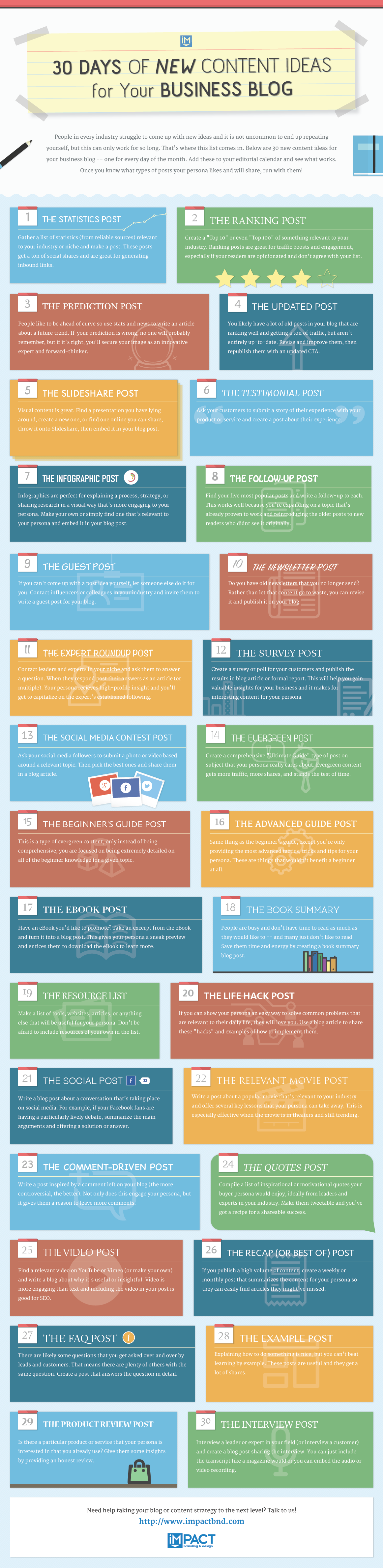
Share this Image On Your Site
30 Days of New Content Ideas
Day 1. The Statistics Post
Gather a list of statistics (from reliable sources) relevant to your industry or niche and make a post like this one. These posts get a ton of social shares and are great for generating inbound links.
Day 2. The Ranking Post
Create a "Top 10" or even "Top 100" of something relevant to your industry. Ranking posts are great for traffic boosts and engagement, especially if your readers are opinionated and don't agree with your list.
Day 3. The Prediction Post
People like to be ahead of curve so use stats and news to write an article about a future trend. If your prediction is wrong, no one will probably remember, but if it's right, you'll secure your image as an innovative expert and forward-thinker.
Day 4. The Updated Post
You likely have a lot of old posts in your blog that are ranking well and getting a ton of traffic, but aren't entirely up-to-date. Revise and improve them, then republish them with an updated CTA.
Day 5. The Slideshare Post
Visual content is great. Find a presentation you have lying around, create a new one, or find one online you can share, throw it onto Slideshare, then embed it in your blog post. Here's an example of a recent Slideshare post we created.
Day 6. The Testimonial Post
Ask your customers to submit a story of their experience with your product or service and create a post about their experience. User-generated content is awesome because it gets your persona involved and it provides social proof for your brand.
Day 7. The Infographic Post
Infographics are perfect for explaining a process, strategy, or sharing research in a visual way that's more engaging to your persona. Make your own or simply find one that's relevant to your persona and embed it in your blog post. (i.e. our post, 10 Ways to Repurpose Your Content the Right Way)
Day 8. The Follow-Up Post
Find your five most popular posts and write a follow-up to each. This works well because you're expanding on a topic that's already proven to work and it allows you to reintroduce the older posts to readers that may not have seen it when it was originally published.
Day 9. The Guest Post
If you can't come up with a post idea yourself, let someone else do it for you. Contact influencers or colleagues in your industry and invite them to write a guest post for your blog. Their name will drive traffic to your blog and maybe even open the door for cross promotion.
Day 10. The Newsletter Post
Do you have old newsletters that you no longer send? Rather than let that content go to waste, you can revise it and publish it on your blog.
Day 11. The Expert Roundup Post
Contact leaders and experts in your niche and ask them to answer a question. When they respond post their answers as an article (or multiple). Your persona will love this because they are getting high-profile insight and you'll love it because you get ot capitalize on the expert's established following.
Day 12. The Survey Post
Create a survey or poll for your customers and publish the results in blog article or formal report. This will help you gain valuable insights for your business and it makes for interesting content for your persona.
Day 13. The Social Media Contest Post
Ask your social media followers to submit a photo or video based around a relevant topic. Then pick the best ones and share them in a blog article.
Day 14. The Evergreen Post
Create a comprehensive "Ultimate Guide" type of post on subject that your persona really cares about. Evergreen content gets more traffic, more shares, and stands the test of time.
Day 15. The Beginner's Guide Post
This is a type of evergreen content, only instead of being comprehensive, you are focused on being extremely detailed on all of the beginner knowledge for a given topic.
Day 16. The Advanced Guide Post
Same thing as the beginner's guide, except you're only providing the most advanced tactics, tricks and tips for your persona. These are things that wouldn't benefit a beginner at all.
Day 17. The eBook Post
Have an eBook you'd like to promote? Take an excerpt from the eBook and turn it into a blog post. This gives your persona a sneak preview and entices them to download the eBook to learn more.
Day 18. The Book Summary
People are busy and don't have time to read as much as they would like to -- and many just don't like to read. Save them time and energy by creating a book summary blog post, like this one
Day 19. The Resource List
Make a list of tools, websites, articles, or anything else that will be useful for your persona. Don't be afraid to include resources of your own in the list. Posts like this get a lot of shares and traffic.
Day 20. The Life Hack Post
If you can show your persona an easy way to solve common problems that are relevant to their daily life, they will love you. Use a blog article to share these "hacks" and examples of how to implement them.
Day 21. The Social Post
Write a blog post about a conversation that’s taking place on social media. For example, if your Facebook fans are having a particularly lively debate, write a post summarizing the main arguments and offering a solution or answer.
Day 22. The Relevant Movie Post
Write a post about a popular movie that's relevant to your industry and offer several key lessons that your persona can take away from it. This is especially effective when the movie is in theaters and still trending.
Day 23. The Comment-Driven Post
Write a post inspired by a comment left on your blog (the more controversial, the better). Not only does this engage your persona, but it gives them a reason to leave more comments.
Day 24. The Quotes Post
Compile a list of inspirational or motivational quotes your buyer persona would enjoy, ideally from leaders and experts in your industry. Make them tweetable and you've got a recipe for a shareable success.
Day 25. The Video Post
Find a relevant video on YouTube or Vimeo (or make your own) and write a blog about why it's useful or insightful. Video is more engaging than text and including the video in your post is good for SEO.
Day 26. The Recap (or Best of Post)
If you publish a high volume of content, create a weekly or monthly post that summarizes the content for your persona so they can easily find articles they might've missed.
Day 27. The FAQ Post
There are likely some questions that you get asked over and over by leads and customers. That means there are plenty of others with the same question. Create a post that answers the question in detail. This will help out those who see it on your blog and you'll have a resource that you can link to people when they ask you the same question again.
Day 28. The Example Post
Explaining how to do something is nice, but you can't beat learning by example. These posts are useful and they get a lot of shares. (i.e. 10 Examples of Email Re-engagement Campaigns You'll Want to Steal.)
Day 29. The Product Review Post
Is there a particular product or service that your persona is interested in that you already use? Give them some insights by providing an honest review.
Day 30. The Interview Post
Interview a leader or expert in your field (or interview a customer) and create a blog post sharing the interview. You can just include the transcript like a magazine would or you can embed the audio or video recording.
Free Assessment:
/Assets/Icon%20Library/Arrows/Grey%20Arrow%20-%20Prev.svg)
/Assets/Icon%20Library/Arrows/Grey%20Arrow%20-%20Next.svg)